


In summary: To get to the Arrecife de las Sirenas, drive towards the Cabo de Gata lighthouse and, just before the small restaurant on the left, take the path leading to the viewpoint. There is a free car park there with space for 10 or 12 cars. From the car park, a footpath of about 200 metres leads down to the cove. In summer, go before 9.00 am or after 6.00 pm.
Getting to Arrecife de las Sirenas is easy, but the final stretch isn’t signposted and there’s very little parking. We’ll tell you which way to go in, where to leave your car and what the walk down to the cove is like.
Index
How to get to the Sirens’ Reef: where to park
-
The nearest one
PViewpoint car park
- Places
- About 10 or 12 cars
- Price
- Free
- To the reef
- A path about 200 m long
It’s best to arrive first thing in the morning. It’s right next to the viewpoint and the park’s information point.
-
PNext to the lighthouse
- Where
- A little further on, at the Cabo de Gata Lighthouse
- Places
- More space
It’s better if the car park at the viewpoint is full. You’ll have to walk back.
-
From the sea
- How
- Kayaking, with a guide
- Departure
- La Fabriquilla
It’s best if you want to see the rocks up close and leave the car behind.
During the high season, there are traffic jams on the road up to the lighthouse and the car park fills up.
- Best moment
- Traffic jams and a full car park
In June and September, you just need to arrive before 10.00. The rest of the year, there’s usually space available throughout the day.
How to get to the Arrecife de las Sirenas by car
- Village of Cabo de GataTake the AL-3115 road, which leads out of the neighbourhood towards the lighthouse.
- The Las Salinas straightIt’s a long straight stretch between the beach and the salt flats. La Fabriquilla is at the end of it.
- The climb up to the lighthouseOnce you’ve passed La Fabriquilla, the road climbs up the hill. It’s narrow and winding, and in some places there’s only room for one car.
- The turn-off, just before the restaurantBefore you reach the lighthouse, you’ll see a small restaurant on your left. Just before that, there’s a path: that’s the one. The Aula del Mar is on your right.
- The car parkIt’s on the left, just before a sign restricting access to "Easement". Next to it are the viewpoint and the information point.
The walk down to Cala de las Sirenas
From the car park, a path leads off to the right and winds down to the coast. It’s about 200 metres: it takes 5 to 10 minutes to walk down and 10 to 15 minutes to walk back up. It isn’t signposted, but it’s easy to follow as it’s well-trodden. The terrain is rocky and uneven, so forget about flip-flops.
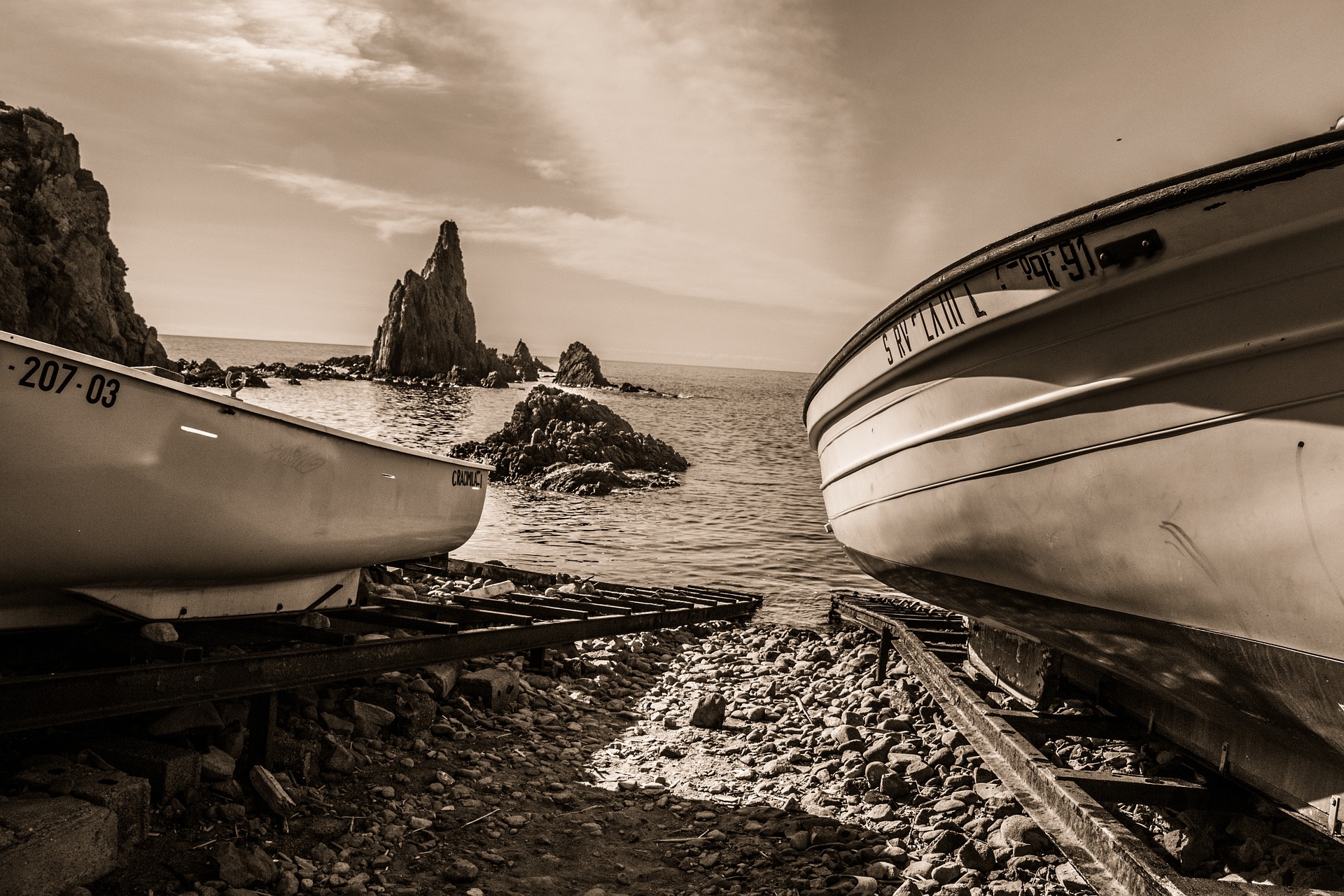
When you reach the bottom, you’ll see some rusty rails – the sort that used to be used to haul the boats out. Turn right, go past some rocks and you’ll be at the cove. It’s tiny, made up of rocks and pebbles, with no sand at all, and there’s only room for a few towels: if the tide is a bit high, there’s hardly any space left.
- Footpath
- About 200 m, unmarked
- Difficulty
- Easy to medium
- Services
- None
- Accessible
- Just the viewpoint
What is the Sirens’ Reef?

These are the remains of ancient underwater volcanic chimneys. As the sea level fell over millions of years, they were exposed, and the water and wind have shaped them into their present form. The name comes from the monk seals that used to live on these rocks: from a distance, sailors mistook them for mermaids. There are none left now.
In the morning, the water is a deep turquoise blue; in the afternoon, it’s the silhouettes of the rocks against the sea that stand out. You can find the full story in our guide to the Mermaid Reef.
Things to do at the Arrecife de las Sirenas
Firstly, the viewpoint: it’s next to the car park, is accessible and has information boards. Secondly, snorkelling, because the water is very clear and the seabed consists of rock and Posidonia. And if you want to see it from the water without walking down the path, you can book the kayaking trip around the Arrecife de las Sirenas, which sets off from La Fabriquilla. Here are all the activities in Cabo de Gata.
Excursions and activities in the area
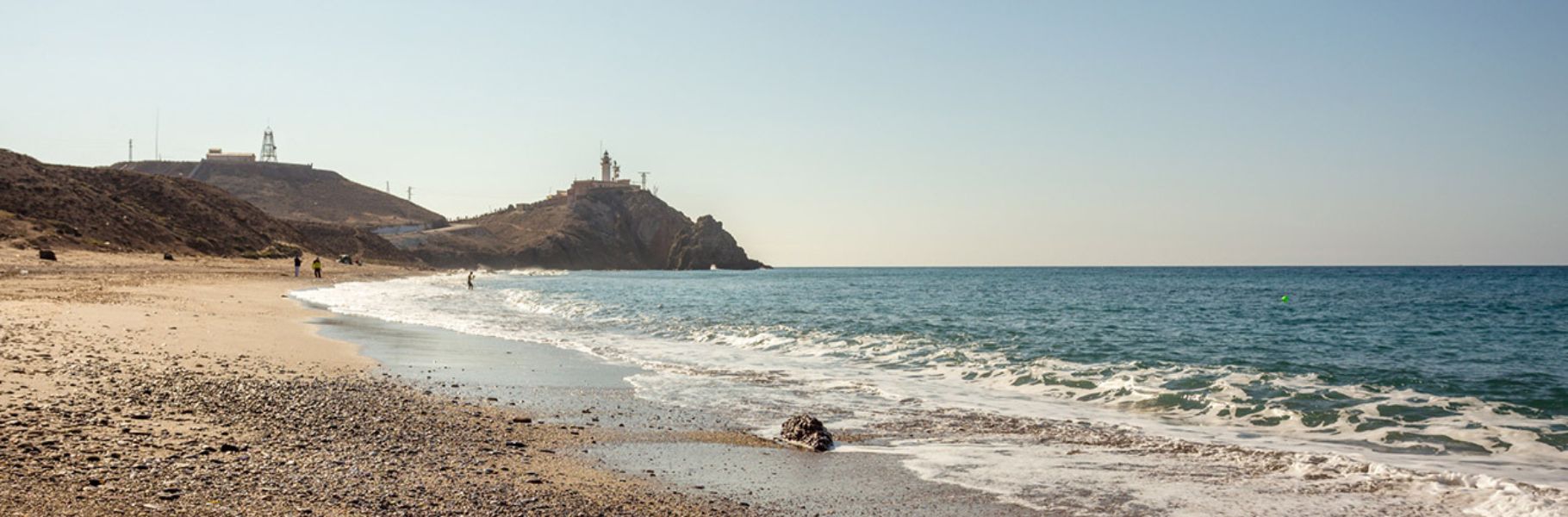
If you’re left wanting more, you can walk from the lighthouse to the Corralete Beach, and along the coastal path, Cala Arena and Cala Rajá.
Tips for your visit
- Closed-toe walking shoes for the trail and water shoes for the water: the seabed is rocky and there may be sea urchins.
- There are no facilities. Bring water, something to eat and sun cream, and take your rubbish away with you.
- The wind blows stronger near the lighthouse. Check the sea conditions before going for a swim, and don’t swim alone.
- It is a Nature Reserve: you must not camp, light fires or take anything from the seabed.
More places to visit in Cabo de Gata
 Guide to the Mermaids’ Reef
- Corralete Beach
- Genoveses Beach
- The 3 most beautiful villages in Cabo de Gata

Frequently asked questions
Where can you park if you’re going to the Arrecife de las Sirenas?
Next to the viewpoint there is a very small free car park, with space for around 10 or 12 cars. If it is full, you can park a little further on, next to the Cabo de Gata Lighthouse, and walk back to the viewpoint.
How long does it take to get down to the Sirens’ Reef?
The path from the car park is about 200 metres long. It takes 5 to 10 minutes to walk down and 10 to 15 minutes to walk back up, as the return journey is uphill. It is not signposted and the terrain is rocky, so you should wear closed-toe shoes.
Do you have to pay to see the Sirens’ Reef?
No. Access to the viewpoint and the cove is free of charge, and there is no charge for parking either.
Is it possible to visit the Arrecife de las Sirenas with a pushchair or wheelchair?
You can get to the viewpoint: it’s a paved platform next to the car park. You can’t get to the cove, though, because the path is rocky, uneven and not accessible.
Can you get to the Arrecife de las Sirenas by public transport?
Only partly. There are buses from Almería to the village of Cabo de Gata, but from there it’s about 7 kilometres to the reef, which you’ll have to cover by taxi or on foot.
Why is it called the Mermaids’ Reef?
Because of the monk seals that used to live on these rocks. Sailors and fishermen, seeing them from a distance, mistook them for mermaids. Today, there are no longer any seals at Cabo de Gata.

