



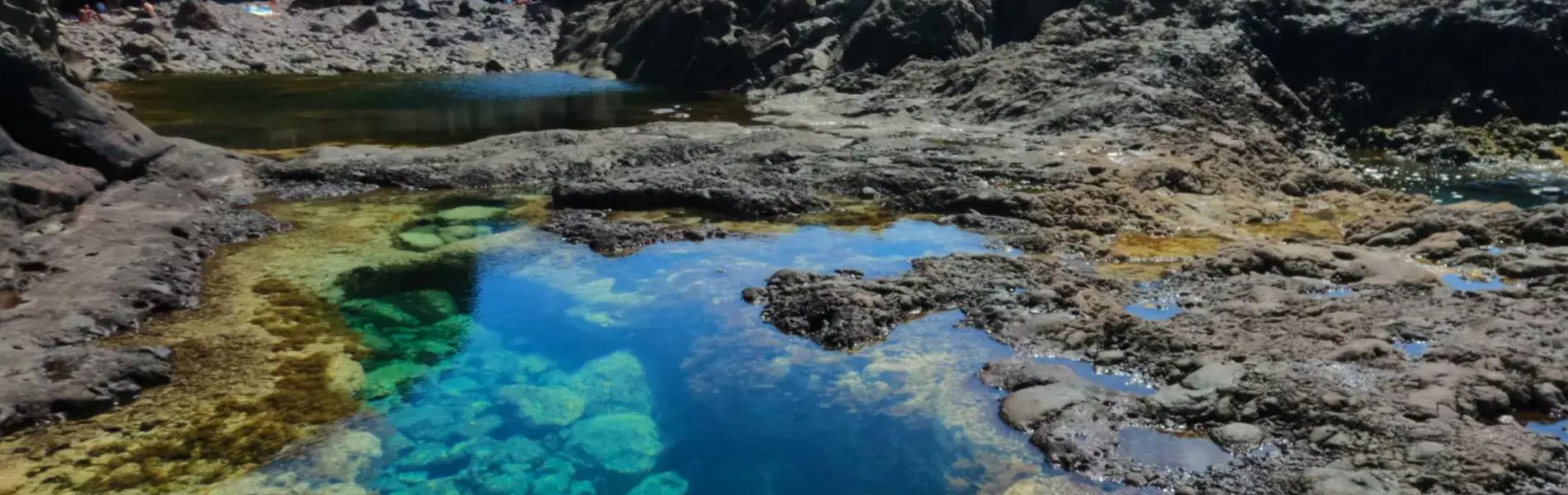
In summary: The Charco de los Espejos is a natural pool of emerald-coloured water in Gáldar, at the foot of the Sardina del Norte lighthouse, in the north of Gran Canaria. You can park at the lighthouse and walk there in about 10 minutes along the coast. It’s only worth visiting at low tide when the sea is calm; at high tide, the water covers the rocks.
Of all the pools along the north coast of Gran Canaria, Los Espejos is one of the least well-known and most photogenic: a pool formed from volcanic rock where, when the water is still, it reflects the sky and the cliff face like a mirror. Here’s exactly where it is, how to get there and when to visit.
Index
Charco de los Espejos: what it’s like
-
Pond details
Charco de los Espejos
- Where
- Gáldar, next to the Sardina del Norte Lighthouse
- What is it?
- A natural pool amongst volcanic rocks
- Water
- Esmeralda, very transparent
- Services
- None
- Car park
- At the lighthouse, a 10-minute walk away
- Better with
- Low tide and calm seas
The name comes from the mirror-like effect of still water, particularly at sunset.
-
You’ll like it if…
- Are you looking for
- A quiet, picturesque spot
- Do you like it?
- Snorkelling in calm waters and sunsets
Best for a one- or two-hour stop on a trip up north.
-
Better to go somewhere else if…
- Do you want to
- Spending the day at the beach with facilities
- There are
- High tide or swell
Sardina del Norte beach, just next door, is the most convenient option.
How to get to Charco de los Espejos from Sardina Lighthouse
- The GC-2 road towards AgaeteFrom Las Palmas, take the GC-2 towards Agaete. About 3 km before you reach Agaete, take the turn-off for Sardina del Norte.
- Follow the signs for Sardina LighthouseDrive through Sardina and carry on to the lighthouse, where the road ends.
- Park at the lighthouseThere’s space to park your car next to the lighthouse. From here, you can already see the coastline along which the footpath runs.
- Coastal path, about 10 minutes’ walkHead out to the right of the lighthouse, facing the sea, and follow the path that runs along the coast. There are loose stones, sections of sharp rock and some uneven ground: make sure you wear closed-toe shoes.
It takes about half an hour by car from Las Palmas, and around 45 minutes from the airport. You can take the bus to Sardina del Norte; from the village, you’ll need to walk to the lighthouse and follow the path.
Tides and waves: when to go
This pool is entirely dependent on the tide. At low tide, there is a sheltered, clear pool where you can float and see the seabed. At high tide, the water covers the rocks, the pool disappears and it becomes difficult to pass along the path. Check the tide table before setting off and try to arrive when the tide is ebbing.
The north of Gran Canaria faces the Atlantic swell head-on. If the sea is rough, don’t even go near the rocks: the waves crash into the pool without warning. The best days are calm ones, and the best light is in the late afternoon, when the water acts as a mirror.
What to see near Charco de los Espejos
- Sardina del Norte Lighthouse. The starting point, with views across the entire coastline and one of the most famous sunsets in the north of the island.
- Sardina del Norte Beach. A small, sheltered beach with dark sand, and seafood restaurants in the village.
- The Painted Cave at Gáldar. The island’s most important museum and archaeological park, in the centre of Gáldar.
- Agaete and Puerto de las Nieves. About a 15-minute drive away, with its natural pools, the Dedo de Dios and the coffee plantations.
Things to do in the north of Gran Canaria
You can see the lake in a couple of hours, and the northern part takes a whole day. Here are all the things to do in Gran Canaria.
Tips for your visit
- Check the tide and the swell before you set off. Without low tide, there’s no pool.
- Calzado cerrado para el sendero y escarpines para el agua: todo es roca volcánica afilada.
- No hay sombra ni servicios. Lleva agua, protección solar y llévate la basura.
- No hay socorrista. No te bañes solo ni con mar de fondo.
- Para la foto del espejo, ve al atardecer y con el agua quieta.
More places to visit in Gran Canaria
Frequently asked questions
Where is Charco de los Espejos?
On the north coast of Gran Canaria, in the municipality of Gáldar, next to the Sardina del Norte lighthouse. It is a natural pool set amongst volcanic rocks, very close to the village of Sardina.
How do you get to Charco de los Espejos?
Take the GC-2 to the Sardina del Norte turn-off and follow the signs for the Sardina Lighthouse. Park next to the lighthouse and walk for about 10 minutes along a path that runs along the coast; the path is stony and has some uneven sections.
When is the best time to visit Charco de los Espejos?
At low tide, the sea is calm. At high tide, the water covers the rocks and the pool disappears or becomes dangerous; when there is a northerly swell, you must not go swimming. At dusk, the light on the water is what gives it its name.
Is it possible to go snorkelling at Charco de los Espejos?
Yes. When the water is still, you can see small fish and the volcanic rock at the bottom thanks to the clear water. It’s a small pool, so it’s more for floating and looking around than for swimming.
Are there any facilities at Charco de los Espejos?
No. It is a natural area with no showers, toilets, lifeguard or shade. The nearest facilities are in Sardina del Norte, just a few minutes’ drive away.
Is it suitable for children?
Under supervision, at low tide and when the sea is calm, yes. The path is made of sharp rocks and is uneven, so closed-toe shoes are recommended and you should keep an eye on them at all times.

